How to Price a Cabinet Job Accurately (Without a Spreadsheet)

If you've been in the cabinet business for more than a season, you know the feeling. You submit a quote, win the job, and somewhere around week two you realize you've left money on the table. Maybe you forgot to account for the waste factor on the plywood. Maybe hardware costs crept up since you last updated your spreadsheet. Maybe you just got busy and rushed the estimate. Underquoting is one of the most common ways cabinet shops quietly bleed margin.
Why Cabinet Pricing Is Genuinely Difficult
A kitchen isn't a single product. It's twenty to forty individual pieces, each with its own material list, hardware requirements, and labor hours. Price one cabinet wrong and it ripples across the whole job.
Here's what you're actually tracking every time you write a quote: sheet goods by species and grade, solid wood for face frames and doors, hardware from multiple vendors, shop labor by task, waste factor, delivery and installation, and your markup — which needs to cover overhead, not just material cost. Any one of those line items can throw off a quote if the number is stale or the formula is wrong.
The Consistency Problem
The hidden cost of spreadsheet pricing isn't just the occasional bad quote. It's inconsistency. Two people in your shop estimating the same job will often land on different numbers — not because one of them is wrong, but because the process isn't standardized.
That inconsistency adds up. It means customers can't predict your pricing. It means your margins vary job to job for no good reason. And it means every estimate takes longer than it should.
What Accurate Pricing Actually Requires
Getting cabinet pricing right requires three things working together: an accurate takeoff, current costs, and a consistent formula — waste factor, labor rates, and markup applied the same way every time.
Most shops have some version of all three. The problem is they live in different places — a spreadsheet here, a notes doc there, a price list in someone's email — and pulling them together for each quote takes time and introduces error.
A Better Approach
When you design a cabinet layout in Cabora, the material list, hardware list, and pricing are generated directly from the design. Update a dimension, the cost updates. Add a drawer stack, the hardware count updates. Change your markup rate, every line item reflects it.
You're not re-entering data. You're not hoping your spreadsheet formulas held up. You're working from one source of truth that produces consistent quotes, every job.
If you're ready to stop patching spreadsheets and start producing quotes you can trust, visit cabora.ai.
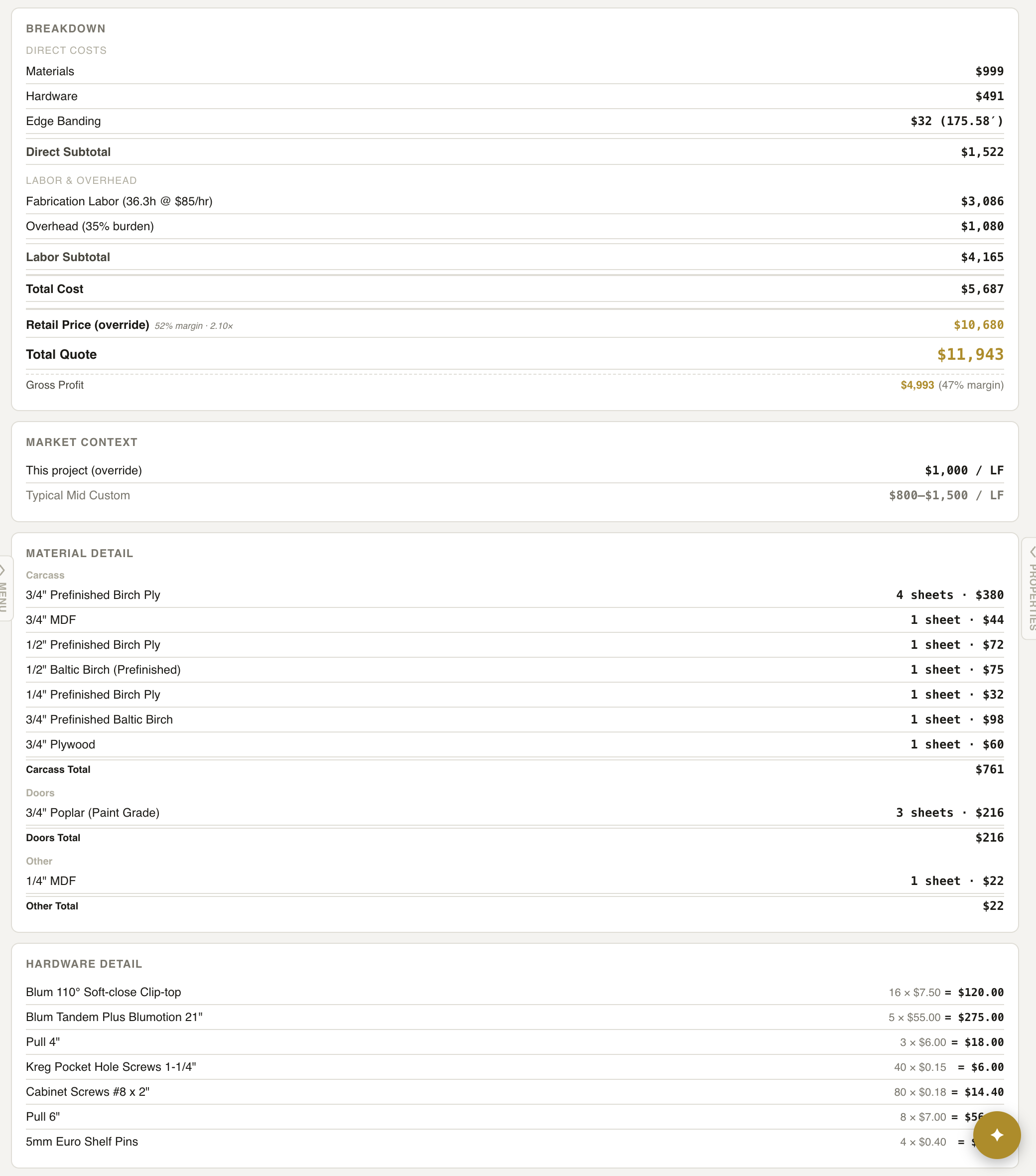
Every quote line — materials, hardware, labor, overhead, margin — flows from the design in a single view.
- Cabinet pricing has many moving parts — any stale number ripples across the whole quote
- Inconsistency between estimators is as damaging as individual errors
- Accurate pricing needs one source of truth for takeoff, costs, and markup
- Cabora generates pricing directly from the design — update the layout, the quote updates